
2026-09-15 · Piquora
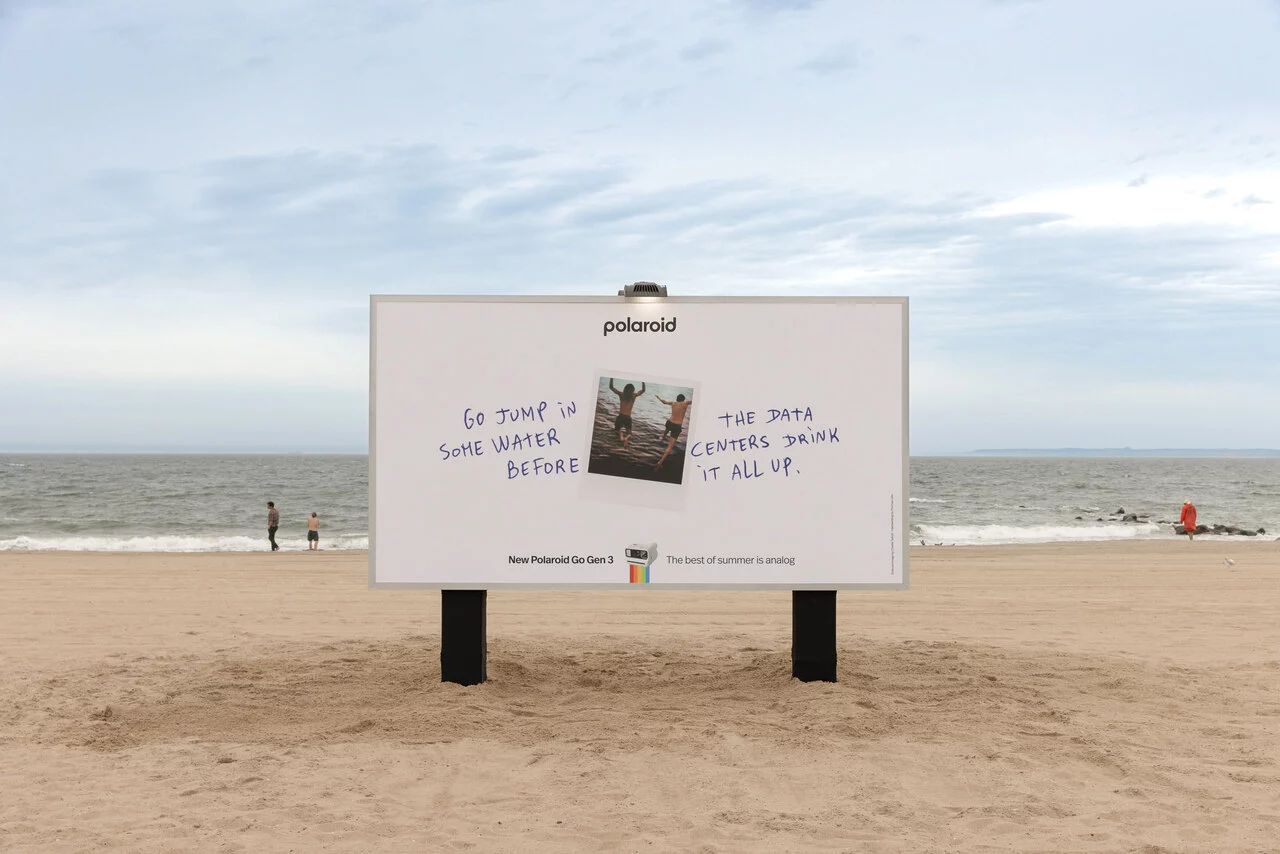
On 18 June 2026, Polaroid planted a giant billboard in the sand at Coney Island. Over an instant photograph of swimmers, a handwritten line told passers-by to get into the water before data centers drink it all up.
It is a sharp image because it makes invisible infrastructure feel suddenly physical. Every cloud service, camera backup and AI prompt runs somewhere: in buildings full of computers that require electricity and cooling. Polaroid placed that reality beside an ocean, then used an instant photograph to ask what all that computing is for.
The slogan works as advertising because it exaggerates. Data centers do not all use water in the same way, and the ocean behind the billboard is not the water normally used to cool servers. Some facilities use evaporative cooling and consume significant freshwater; others use closed-loop or dry-cooling systems that can greatly reduce direct consumption. Climate, design, electricity source and local water stress all matter.
Still, the concern is real. Lawrence Berkeley National Laboratory estimated that United States data centers directly consumed about 66 billion litres of water in 2023 and projected a broad range of 60–124 billion litres a year by 2028. Those national totals can hide the issue people experience most directly: a large new facility concentrating demand in one community.
The International Energy Agency also stresses scale and uncertainty. Data centers used about 1.5% of global electricity in 2024, and their electricity demand is projected to more than double by 2030. Cooling accounts for a varying share of facility energy use, while electricity generation can add an indirect water footprint beyond the water used on site.
The useful question is not whether every digital photo is bad or every physical photo is good. It is whether our technology helps us notice, choose and keep what matters.
Polaroid says the campaign is not anti-digital but “pro-human.” That distinction matters. Instant photography has its own material footprint: film, chemistry, packaging and transport do not disappear because a picture is analog. The campaign’s stronger point is about attention.
A phone makes it effortless to take forty versions of a moment. An instant camera asks for one. The small white frame becomes an object that can sit on a desk, travel inside a wallet or be handed to the person standing next to you. Its limits make the choice visible.
That is also a useful way to approach an enormous camera roll. You do not have to reject digital photography. You can use digital tools to find the few frames that carry a day, a person or a season—then give those frames a more deliberate form.
Choose one recent day you remember clearly. Open its photos and make three passes:
The result is not an argument against the cloud. It is a decision about what should leave the endless scroll and enter your life.